Showing posts with label eating local. Show all posts

Sunday, May 20, 2012

Moving: The Ultimate Test of Living Green

Graduation Day
February 2012 brought with us the culmination of "Five Year Plan." After completing both his Master's and Doctoral Degrees, as well as surviving both a thyroidectomy and a surgery to remove a massive pituitary tumor within 6 months of his defense, Jay was offered a faculty position at East Tennessee State University in Johnson City, Tennessee.  He starts work on my birthday in August.  We'll be living in the Town of Jonesborough.  With all the joy and excitement that come along with seeing a goal met and a dream beginning to coalesce, comes the reality:  HOLY CRAP, we have to MOVE!!! (I'm not the one with the PhD, people, so it took me a while to really have it sink in that we won't just magically appear in the new place complete with chickens and cats.

How does this fit with the theme of the blog?  Well, I try to keep it about living in a 'green' and eco-responsible way.  Apparently moving is the both the Ultimate Test of Living Green, as well as a good opportunity to not only talk the green talk, but also walk the green walk.  Let's start with the basics:  Reduce, Reuse, Recycle.  It turns out that they're all connected.

1. Reduce.  Those of you who know us know that we live in a pretty tiny house.  Less than 800 square feet inside, with a substantially sized glassed-in porch that we don't count as living space. What genius thought that glassing in a sun porch in Florida was a good idea is beyond me. The house we're buying (We've named it "Little Boone") is slightly larger at just over 1100 sq. ft.   We already don't have what we consider to be a lot of stuff, but probably had kept a little more than we might have otherwise because in our minds 'the next house will be bigger.'  Well, yes... but not enough to really count.  So we've been reducing like crazy.  I've gone through just about every room in the house and have found things I think we can live without.  The hardest decisions for me were shoes and pens.  I expected to have some separation anxiety and guilt over the culling of the shoes. I loves me some shoes, people! None are crazy cute heels. All are cute, sensible and comfy. Merrills, Chacos, Keens, OH MY!  I probably should have taken the opportunity to count the ones that made the cut, but I forgot, and now the winter-ish ones are packed. Oh, Darn.  Now we'll never know how many I have (and stop calling me Imelda!) The pens, now, were a surprise.  It wasn't that I was somehow emotionally attached to the pens.  I just didn't want to be environmentally irresponsible and throw out perfectly good pens, and who would buy a used pen at the thrift store?? But how many pens do two people in the age of digital communication really need?  My reduction in pens and other associated writing implements resulted in the use of another of the Three R's: reuse.  I gave them to a school teacher for use in the classroom.  As a former teacher, I get how much of your own money you spend on basics, so I felt much better that my reduction was someone else's gain, and that I didn't have to clog up a landfill with half-used gel-pens from my paper journaling phase.

2. Reuse.  This one was a bit easier.  We had a need to reduce, and we knew a lot of our stuff was re-usable.  One of the girls at our favorite local  Tea Shop, TeBella Tea Company, was getting her very first apartment.  I'm not the maternal type, generally, but if I had wanted a daughter to call my own, Brooke would be it.  She's smart, strong, hard-working and responsible.  She manages to be all those things and also be just the sweetest kid on earth.  She also needed "stuff."  And boy did we have stuff to spare. While I was doing my Reducing, I kept a "Brooke Box," and managed to fill it several times over with all kinds of kitchen supplies as well as our kitchen table and chairs.  By reducing the amount of stuff we were having to move, Brooke is able to reuse some of it.  Warms the cockles of my hippie green heart, it does.

3. Recycle.  I had fun with this one.  I recycled a bunch of old t-shirts into yarn a while back, and realized how many crafty activities can benefit from recycling.  Right around the time we started getting ready to move, a really cool business opened up in Ybor City.  It's called Tampa Upcycle.  Morgan takes in all kinds of supplies that crafters and artist no longer need and provides a place for them to live until another crafter or artist comes by and gives them a home. She puts it best on her website: "Tampa Upcycle is an arts and crafts supplies boutique that collects and offers used (and some new) art supplies such as paints, canvasses and brushes, sewing supplies such as fabrics, notions, and patterns, and craft supplies such as scrapbooking papers and embellishments, yarns and tools with “pay-as-you-wish” pricing. The idea is to have a central location where indie artists, designers and crafters can find materials that can be repurposed and made into something new. Everything from partially used paints to vintage sheets to cereal boxes."   Isn't that just the coolest? It appeals to me on so many levels. Another box was soon filled with Tampa Upcycle stuff.  I took every scrap of wrapping paper, gift bags, little glass bottles, and all kinds of crafty supplies up there and donated them.  I would love to be a part of something community-minded like that when we move.  I recently took a class to reacquaint myself with my decades-old sewing machine at Tampa Upcycle offered by Tampa FreeSkool.  FreeSkool is  community based education in action.  Basically, if you have something you know how to do, and can teach it to others for free, you are encouraged to do so.  Things like beer making, to friend-making, to yoga, to fun with compost.  Recycling your knowledge, in a way, and making it available to those who want to learn for themselves.  This is something else I'd love to get going in Tennessee, if it doesn't already exist. 


Little Boone
We will also be re-using and recycling the Little Boone house.  Built in roughly 1941, it's a bungalow style home at the top of a little hill on Boone Street, across the street from the Visitor's Center, Town Hall and the Library.  Our good friends Terry and Sandy own it, and I've actually been calling it "the house we'll live in when we move to Jonesborough" for close to ten years.  Go figure.  You can't see it in this photo, but it has a green (!!!) tin roof, and sits on a nice big yard that is just waiting for a chicken coop, worm composter, daylilies, a square foot herb garden and a hydroponic farm. Because it's small, we'll continue trying to live minimally, and reduce our footprint.  I love the idea of living in a house with history.  We will be in walking distance of the Old Towne Pancake House, Main Street, with the Farmer's Market, The Storytelling Center, and Music on the Square.  There is a shop called Boxcar Betty's Eco Depot and another called Hands Around the World that feature upcycled and hand made items. Add to this a Lavender Store, a Cupcake Shop and Artisan Chocolates. The only thing I think we're really going to mourn is a cup of really good loose leaf tea.  There are two really good restaurants in town, and another opening soon, but nobody serves good tea. We might have to change that!   


(sub)Urban Farming

This is a reprint of my very first published article in the 2012 Spring Region 12 Newsletter for the American Hemerocallis Society.  I had never really thought I wanted to write for publication before, but I actually had a good time with it, and with writing the local club news article at the back of the issue. My apologies for the redundancy to those of you who have followed the blog.  If you know me, you already know all of this. But I hope you enjoy the recap!

When Greg Crane asked me to write a piece for the newsletter about “Chickens and Daylilies” I was, frankly, stumped. I’m a part-time blogger, and I’ve written about our chickens, and I’ve written about our daylilies on www.cari-daway.blogspot.com. But I 
never really thought about “Chickens AND Daylilies.”  A few weeks were spent with this 
concept rolling around in my mind, and more than a few attempts at writing that were actually spent looking at a blank screen and a blinking cursor. I asked the Facebook universe for ideas. My friend Timi said she understood my block by equating her being asked to write about her jeep and her dogs: two things she loves but don’t really intersect. 

One of our daylily club friends, Kyle Pierson, said that the feathers of the chickens could be like the colors in daylilies, or that going out to see the flowers in the morning is like looking for eggs. All are valid points. But nothing really lit my literary pilot light. I 
flirted briefly with the comparison of my hobby of collecting lists of potential chicken names (such as Magdalena Van der Flocken) with some daylily enthusiasts’ hobby of collecting lists of potential daylily names (I know you’re out there. Terri Jones can’t be the only one who does this!) Then it hit me: Poop! Yes, poop. Not literally, thank goodness. Put a pin in that thought, we’ll return to it in a few minutes.

I realized that the chickens were an integral part of the mini eco-system we’ve created in
our little neighborhood city lot. My husband and I both have green thumbs. I also have a
passion for healthy organic food and a clean environment that borders on the obsessive
(and occasionally annoying.) These qualities combined a few years ago into a 10-tower
hydroponic garden, a square-foot garden for my kitchen herbs and natural pest control
aphid-trapping bed, a worm composter and traditional compost bin, and our chickens:
Phyllis, Pearl and Francine. We also grow about 150 daylily cultivars. Small potatoes in
the daylily world, but when you consider how tiny our house and lot is, that’s about all
we have room for. I believe that in the chemical sense, one should impact the earth as
little as possible, but while doing that impacting, one should get as much out of it as one
can in the space allotted.

In the hydroponic garden, we grow enough produce to feed ourselves, the chickens, the
neighbors, my Pilates instructor, the girls at the local tea shop and sometimes our friends,
family and co-workers. The catnip grows especially well, as do tomatoes, Swiss chard,
onions, carrots, basil, snow peas, broccoli, cabbage, cucumbers, beans and many other
things. The ability to grow 6 times the produce in the same space as conventional
gardening appeals to me, as does the ability to do it without chemical pesticides,
fertilizers or fungicides that leach into the water table or harm wildlife. The only real
challenge we had was squirrels. Eventually Jay caged in the entire structure with chicken
wire, and that has kept out the squirrels, but continues to let in a tiny field mouse with
whom we’ve agreed to share. He doesn’t eat as much as a dozen squirrels do, so it seems
like a good balance. And the structure only looks a little bit like a prison camp….. but I
digress.

  Two years ago, Jay and I decided to get chickens. He spent about two months of
weekends and a spring break building a really nice coop. He is especially proud of its
door. In April of 2010 we brought home Babette, (who later grew into Bobette and had to go back to the farm) Sylvia, Pearl and Phyllis. Sylvia has since passed away, but Francine recently joined our flock. During the construction of the coop, Jay had dug up and potted all the daylilies so he’d have room to work without having to worry about tromping all over them in his many trips back and forth across the yard. When the coop was finished, he built two big (for our yard, about 8’ x 8’) raised beds about 18” high, to put all the daylilies back into. Here’s where the poop comes in. I told you we’d get back to that.

We – and let there be no doubt that when I say “we” it is all “Jay” - filled the beds with 
compost and bagged oak leaves we liberated from lawns and curb sides all over South
Tampa. But what really got the beds ready for replanting for the daylilies were the 
chickens. We finally got brave enough to let our very spoiled, indulged, coddled and
generally over-protected city chickens out of the coop to free-range every afternoon
(supervised closely, of course.) Jay tossed sunflower seeds up into the empty beds and the girls hopped in and started turning over the soil and, well, pooping. Poop = fertilizer = daylilies. Happy daylilies. 2011 was our best daylily season ever. The sunflower seeds in one of the beds did not get eaten as much as the other, so at one point we had a bed full of giant sunflowers with happy daylilies growing in their shade. When it became time to cut down all the sunflowers to give the daylilies room to grow, I dried the heads and gave them to the chickens. Poop = fertilizer = sunflowers = chicken treats = eggs + poop.

Every morning, Jay takes organic brown rice mixed with organic yogurt out to “the
girls,” and in bloom season he deadheads the daylilies and chucks them into the chicken
coop along with some Swiss chard, field-mouse-chewed tomatoes, or carrot tops from the
hydroponic garden. Since we don’t ever spray any dangerous chemicals in our daylilies
or in our hydroponic garden plants, we can safely feed them to the chickens. Poop =
fertilizer = daylilies + hydroponic vegetables = chicken treats = eggs + poop.
Since we have the chickens, and because I’m pretty militant about not spraying chemicals all over the yard that my chickens and invited wildlife and beneficial insects frequent, we do occasionally have to deal with uninvited guests such as aphids or sooty mold in the veggies that are in the squash family. This is where the worm composting and square foot garden comes in. Worm tea is a great anti-bacterial and insecticide that is safe to use in the garden. Gaura lindheimeri 'Whirling Butterflies’ is an aphid magnet. We plant it in a small square foot bed in relative close proximity to other plants that are aphid candy like daylilies or hibiscus, and the aphids glom onto the stems of the Guara and tend to stay off the plant we actually care about. Jay calls the stems “Aphid Popcicles” because I cut them off when they’re loaded up with aphids and feed them to the chickens. In the past, I’ve brought in ladybugs to then eat the aphids, but for the last couple of years, I just let the chickens eat them. If the aphids wipe out the Guara it’s not a big loss since they reseed like crazy, and are only $3 at the garden center. They’re cute, too. Worm tea + castings = Guara = aphid magnet = chicken treats = eggs + poop.

I bet you’re wondering now “What does she do with all that poop?” We make compost,
of course. And the cycle continues. We can use the compost to top dress the daylily
beds, and the butterfly garden, as well as supplement the Guara and my kitchen herb
garden. The compost bin is located next to the door that opens to clean out the hen house,
so I just have to scoop, turn and dump. Of course the garden and kitchen produce waste
that doesn’t get fed to the worms or the chickens goes into the pile, as well as eggshells
and tea leaves we pick up from a local tea shop and coffee grounds we get from Whole
Foods. It’s also located next to the fence by the neighbor’s yard, so they toss their kitchen waste into it as well.

Our chickens give us enjoyment every day, along with the eggs and poop we use to keep
our daylilies growing. Our daylilies give us enjoyment every day during bloom season,
and are good treats for the chickens. They do look a little like bloody dinosaurs when
they dig into a deadheaded blossom from a red cultivar, though. That can be a little
disconcerting. They love to take dust baths underneath my kitchen herb garden, and also
work diligently to keep down the unwelcome insect population in the yard. We rely on
our hydroponic farm to feed the chickens, and ourselves and compost whatever we can in
order to keep the cycle going. So there you have it. Chicken poop is the substance which
binds our (sub)Urban eco-system together.


.

Tuesday, January 18, 2011

Cari-d Away to Callaway

 Every other year or so in December, we bundle ourselves up in multiple layers of our warmest woolies and drive up to Callaway Gardens in Pine Mountain, Georgia for some winter wonderland fun at their Fantasy in Lights event.

 The resort starts putting up light displays throughout the park in September, and it takes until around Thanksgiving to install all 8 million lights.  After sundown, you pack up into open-air Jolly Trolleys and are driven through the park to  see all the displays.  I won't show you any of my pictures that I take at night because they never turn out, but you can see them on Callaway's website.  The two pictures above are ones I took of two of the displays the next morning on our drive.

our cottage
The resort has many options for lodging.  We usually get either a cottage or a villa lock-out (when someone rents a 3 bedroom villa but only needs two of the rooms, we rent the third at a significantly reduced rate).  This year our cottage overlooked part of the 10 mile bike trail.


Butterfly Conservatory
The morning following the light show, we have breakfast in either a country style restaurant or the new restaurant in their Lodge and Spa building, then we tour some of the garden sites.   There is the Ladybird Johnson Wildflower trail, the location of the Southern Victory Garden and our favorite, the Butterfly Conservatory.
Inside this glassed-in structure are literally thousands of butterflies - over 2700 the day we were there, according to the Butterfly Count board.  There are butterflies hatching in a display, and then once you walk into the humid tropical enclosure, you see them everywhere... flying, feeding, just hanging out.  It's a magical place.


ladybugs
We walk around in this lush indoor garden, looking all around at the butterflies that are on plants, feeding on fruit, walking around on benches and windows and even landing on people.  There are even hundreds of ladybugs, part of the garden's practice of using natural pest control methods instead of chemical pesticides.  Ladybugs LOVE aphids, so having them hatch out colonies of the little red and black buggies help to control the aphid population on the host and feed plants for the butterflies.  We do the same thing in our yard every year, too.
the hatching display


feeding tray


greens and cabbage
Next we moved on to the Victory Garden.  The resort employs 6 full time gardeners on the 7.5 acre plot. They grow veggies that are used in the in-park restaurants, and they also sell the excess to park guests.  Of course while we are there in the winter, all that's really growing are collards and cabbages, but my gardener's eye could fill in the blank spots that I'm sure come spring and summer are filled with all sorts of produce.  The park gardens also serves as a testing ground for new varieties, and also employs natural and 'green' growing practices to treat pests and diseases, should issues like that arise.

There is an herb garden as well as a sundial garden, and some really nice shady spots that I'm sure are welcome in the warmer weather.  They film some of the PBS Victory Garden tv show episodes from there.  We always say that 'next year, we should come back and see the park in the spring or fall when everything is blooming' but so far we haven't. I'm sure that when the azaleas and rhododendrons are in bloom the entire mountain is swathed in rosy pink and fuschia.

Jay on the victory garden porch
This is one of our favorite places to go, and I can heartily recommend it to anyone in need of something to get them in the Christmas spirit.  We've talked about spending Christmas there, treating ourselves to the spa and sipping cider by a roaring fire...Maybe next year will be the year we actually try out those bike trails and see actual wildflowers growing on the wildflower trail, and actual veggies in the veggie garden!

Monday, December 6, 2010

The Swag: Vacation of a Lifetime

view from The Swag
This year, following the The Storytelling Festival, we treated ourselves to a few more days in the Smoky Mountains at The Swag in Waynesville, NC.  We found out about The Swag from one of our all-time favorite storytellers, Donald Davis, and his wife, Merle.  Over the years we've been going to the festival we'd become acquainted with Donald and Merle.  At dinner the last night of the festival, they mentioned that they were going up to The Swag for the next week, where Donald would tell stories in the afternoons and evenings, and also lead hikes and walks and talk about the area in which The Swag is located.  Donald is uniquely qualified for that, since his family settled the area in the late 1700s and Donald himself grew up in Waynesville.  We were going to be in Waynesville for the next week, so we decided we'd see if there was going to be room at the inn, and lucky for us, there was.

'back yard' of the main building
The driveway gate is 2.5 miles from the inn, most of the way up a 5,000+ elevation mountain.  You go up 1,000 feet in elevation on the driveway.  The inn itself was constructed in 1971 on 200+ acres from reclaimed logs from historic buildings, the oldest structure dates back to 1795.  The land was last used as a potato farm, and is bordered by the Great Smoky Mountains National Park.  Four of the six highest mountain ranges are visible from the property.


Jay in front of our lodge
raised beds in the garden
The Swag has won numerous awards including several from Conde Nast and others for the food (much of which is local - some of which is produced on the property's garden) as well.

The Inn has also received 2 green 'eco leafs' on  I Stay Green  and is a member of the Haywood County Green Business Initiative.  I can honestly say we've never been to a more warm and welcoming place.  The staff was around in an unobtrusive way.  The chef-prepared food was amazing, with well-thought-out menus to choose from, that were very healthy and incredibly accommodating for special dietary needs.  There was something for everyone, from locally made venison sausage, fresh fruits and vegetables, to artisan cheeses and fresh cookies at tea time (which sounds way more formal and fussy than it was.)  Three meals, afternoon tea and pre-dinner appetizers are included each day of your stay.  The most unique meal included is the lunch option on the last day. They will either pack you a backpack with lunch to take with you on a hike on the property after you check out, or they'll put it in a picnic hamper, or box it up for you to take with you if you can't stay.  Not to be missed are The Swag Bars (made from copious amounts of chocolate and peanut butter.)

Donald on the Deck
Merle on the Deck


The highlight of our trip were the hikes we took with Donald and Merle.  Donald took us on a hike around the property, and through part of the Smoky Mountains National Park.  He told us all about the trees and plants as well as about local history including the Civilian Conservation Corps project that built the fence (still standing) that borders the Inn and the Park.  We learned how to tell the difference between types of pines and firs, and hiked to an old cabin that was preserved on the grounds of the park.
cabin in the park


Merle was so sweet to walk with me at the end of the group.  I was still in my ankle brace, and was very careful to watch my steps.  The trail was very well maintained, and there weren't a lot of spots that were uneven, so I did really well considering the circumstances.  The Swag lets you choose a walking stick of various kinds of wood that they personalize for you with your name and the year.  Mine was a the most crooked dogwood one in the bunch, and Jay's is a very big, manly and heavy one made from a sassafras sapling.
Lunchtime on the hike


hikers


Our room at The Swag was bigger (and ten times nicer) than our house.  It had two bathrooms, one of which had a jacuzzi tub and a steam shower (which was awesome) and a fireplace, along with the king size bed and XM radio.  The lodge our room was in also had a library, common area with fireplace, sauna and basement racquetball courts.

Ridgeview Room


Malcolm Matthews, Swag Cat

 Another highlight was Malcolm, the Swag Cat.  He's a big gray dude that hangs out around the lodge and basks in the sunshine.  He has a brush conveniently located for all the guests to accommodate his grooming needs.  He also can be found on Facebook, which cracks me up.  

The Swag holds several special events during the months they are open to the public, from storytellers to musicians and naturalists, these special evens make an already magical place even more special.

 Our time at The Swag is going to be a memory we hold onto forever.  The hospitality of Deener and Dan Matthews is unparalleled.  The gorgeous mountain views and weather would be memorable under any circumstances; but to share them with Donald and Merle made this an experience even more precious.   They are two of the most kind and gracious people we've ever met.  We love going to the mountains, and love our time at Storytelling even more - but getting the opportunity to go to The Swag after the festival this year was the icing on the cake.  I'm already setting aside a "Swag Fund" so we can save up to go back - maybe next year.
picnic area near Valley View

fall foliage

near the old park border fence


Tuesday, September 7, 2010

Yes, we "Can"

Summer Mix

Jay grew up canning veggies.  My family never did that, so I'm just learning how.  Luckily our friend Dwain, and his sister Fonda have been mentoring me, and reintroducing the art to Jay.  We just got back from a canning trip to Western North Carolina at Dwain's mountain house in Clyde.  We originally planned on canning bush beans in June when we were there, but the beans weren't quite ready yet.  We lucked out on this trip, because we were able to find fresh local beans  in addition to the tomatoes, okra, onions and corn that we had planned on canning.  We also canned 5 pounds of boiled peanuts, and were a little disappointed that the peanuts we bought in Georgia came from New Mexico.  So much for local!

Dwain and Jay.  And Beans.
Beans
Beans going in the Canner
We started with 2 bushels of green beans, which yielded 46 quarts canned.  Dwain's house is the perfect setting for this, with balconies overlooking the mountain.  In order to not heat up the house, we used a propane turkey cooker on one of the balconies for the canning, and for our prep area as well.  The weather was perfect - about 80 during the day and high 50s at night. His house is in the very center of this photo.  We took it across the valley last time in June.
Dwain's house from across the valley


Boiled Peanuts = Crack
Next, we made boiled peanuts.  They turned out fantastic. I ate an entire pint of them myself the other night when I was nursing my sprained ankle.  Nothing better for a sprained ankle than a crapload of salty goodness, I always say!


Fonda with her mad tomato skills
Jay prepping Summer Mi
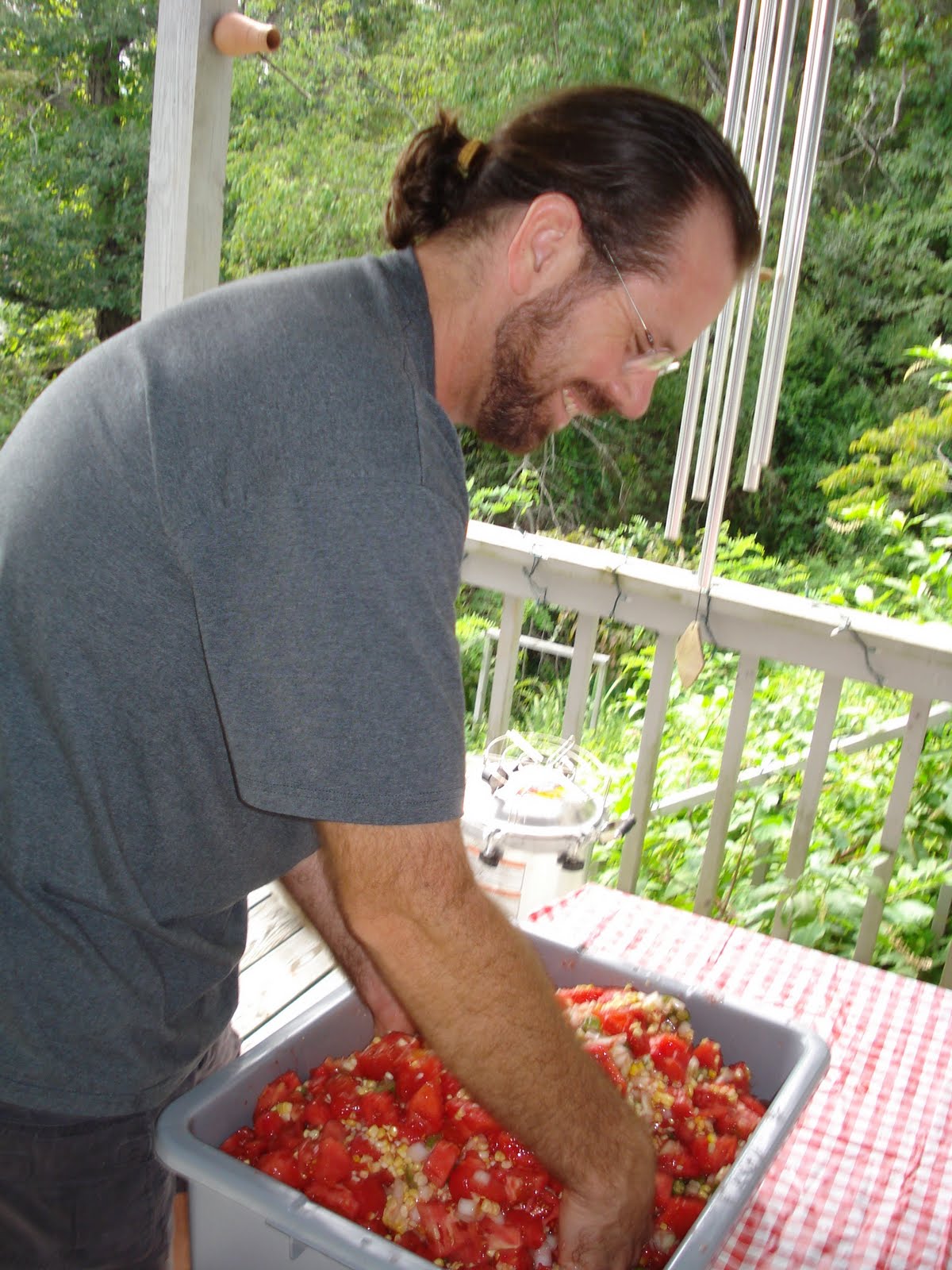
Finally came the tomatoes!  In all, we canned 125 pounds of tomatoes in various forms:  whole, juiced, and in summer mix, which has tomato chunks, sliced okra, vidalia onions and fresh shucked silver queen corn.   We cold-packed the whole tomatoes and the juice, and pressure cooked the summer mix.  Having many hands helped made this so much fun.  I love learning from Fonda and Dwain, and spending time with Jay preparing good food for us to share. When all was said and done, we had 140 quarts of food to bring back home.  We had brought up several dozen boxes of jars, and ended up having to buy more from Tractor Supply (we bought them out of wide mouths) and Ingles (a local grocery store).   I also picked up two canning cookbooks, Put 'Em Up by Sherri Books Vinton, and The Ball Complete Book of Home Preserving so I can start dreaming about what we'll try next.  Fonda always brings fantastic food she grows in Illinois. She made some out-of-this-world creamed corn that I'd love to try my hand at if I can make it with non-cow dairy products.  I'm really grateful to Fonda and Dwain for sharing their 'tribal knowledge' and helping us nourish our bodies and our lives with yummy food goodness!  I'm also grateful that my sweet husband and I have so many shared interests.  It would be hard to do this without his help and ability to pick up extremely heavy canners full of mason jars and boxes full of canned produce. 


We're Egg-static!

Yes, we've joined the ranks of the Backyard Chicken Egg Producers.  2/3 of our hens are producing eggs!  Phyllis started first, about two weeks ago, and Pearl started shortly afterward.  So far Sylvia is very interested in the process, but she has not started laying yet.  I'm going to get her a copy of "Are You There, God, It's Me Margaret" so she won't feel like she's all alone in the world while the rest of the girls are developing ahead of her.


This picture shows our first 7 eggs.  the larger one in the lid of the container is one of the farm fresh eggs we get from Lancaster's our Produce Club Farm I'm a little bummed that our eggs aren't blue/green, because I thought that Ameracaunas always lay blue/green eggs, but a friend of mine told me that they might not lay that color right from the start, so we'll have to just wait and see.


Jay made a fabulous egg scramble for us this weekend, with mushrooms, tomatoes and fresh basil from the garden.  The egg shells are really crisp and hard, and the yolks are very firm and a gorgeous golden color.  They sit up really high and don't get all runny. 

Sunday, June 20, 2010

Eating Local, Even When You're Not

Local, that is.  Preserving and canning some of our local produce, as well as supporting a CSA and growing our own food also contribute to our goal to eat this way.  Even the cats get to take advantage of the catnip we produce in our own back yard.  Recently we canned 4 bushels of field peas, varieties like Black Eyed, Conch, Zipper Cream and Purple Hulled Crowders.  We got these peas about an hour after they were harvested, and had them all canned by the end of the day.  It's hard work, made much easier by using our friend's commercial pea sheller. 


In the last few weeks we also traveled to Arizona, North Carolina and Georgia.  We managed to eat locally everywhere we went. Not every meal, but as many as we could, when we could. 


In Arizona, we went to Queen Creek Olive Mill and toured the orchard, garden and olive oil press room.  They grew a lot of veggies and herbs under shade cloth, and featured locally raised produce in their cafe along with the olive oil.  We had some olive oil cupcakes and gelato and brought some of their signature blend and chocolate olive oil back with us.


While in NC, we went berry picking at The Ten Acre Garden.  Actually, Jay, Dwain and Fonda went berry picking. I was sick and took pictures of everyone else picking.  Between us, we picked 4 quarts of raspberries and blackberries.  Jay made a pie with ours, and Fonda and Dwain made freezer jam with theirs.

On this trip, Dwain also brought peaches and tomatoes from his garden in Plant City, and Fonda brought eggs, milk, pork and squash from her farm in Illinois.  With all the canned goods already stored in Dwain's mountain kitchen, we were able to eat 'locally' most of the time we were there.  On Wednesday mornings, there is a small Farmer's Market in Waynesville that we visited.  Unfortunately, we timed it wrong and were not able to get Bush Beans.  We were about a week or two too early for them to be at market.  We did manage to obtain quite a few baked goods that morning. One of the best items was a Squash and Calendula Blossom yeast bread.  It was light and fluffy and just slightly sweet.  We spotted an English Toffee store on our way out of the Farmer's Market, so of course we had to stop there to do a quality control check on the locally-produced candy.  When we got back to Dwain's house, we were able to spread fresh butter that Fonda had just made as well as the fresh jam on that fantastic squash bread.

Our favorite meal on the whole trip was at The Purple Onion in Saluda, NC.  My pilates teacher told me about this little place, so we made a special trip to Saluda to check it out.  I had locally caught mountain trout roasted in corn husks and served with heirloom veggie salsa.  Jay had locally raised organic chicken and roasted heirloom veggies.  We shared a blackberry cobbler that was out of this world.  As a special treat, we also got to listen to 4 locally-grown singer-songwriters that night.

Even on the way home, when we stopped at a roadside stand for peaches, corn, tomatoes and of course, hot boiled peanuts, we partook of what the local farmers had to offer. Spending time in a place like Western NC, where the vibe is definitely more rural and committed to agriculture inspires me to continue to support local farmers, and fuels my desire to move up there and be a part of that life. I think it inspires Jay, too.  He was quite taken with the tractors at the Farm Supply Store....