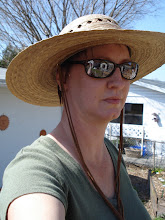
This is a reprint of my very first published article in the 2012 Spring Region 12 Newsletter for the American Hemerocallis Society. I had never really thought I wanted to write for publication before, but I actually had a good time with it, and with writing the local club news article at the back of the issue. My apologies for the redundancy to those of you who have followed the blog. If you know me, you already know all of this. But I hope you enjoy the recap!

When Greg Crane asked me to write a piece for the newsletter about “Chickens and Daylilies” I was, frankly, stumped. I’m a part-time blogger, and I’ve written about our chickens, and I’ve written about our daylilies on www.cari-daway.blogspot.com. But I
never really thought about “Chickens AND Daylilies.” A few weeks were spent with this
concept rolling around in my mind, and more than a few attempts at writing that were actually spent looking at a blank screen and a blinking cursor. I asked the Facebook universe for ideas. My friend Timi said she understood my block by equating her being asked to write about her jeep and her dogs: two things she loves but don’t really intersect.

One of our daylily club friends, Kyle Pierson, said that the feathers of the chickens could be like the colors in daylilies, or that going out to see the flowers in the morning is like looking for eggs. All are valid points. But nothing really lit my literary pilot light. I
flirted briefly with the comparison of my hobby of collecting lists of potential chicken names (such as Magdalena Van der Flocken) with some daylily enthusiasts’ hobby of collecting lists of potential daylily names (I know you’re out there. Terri Jones can’t be the only one who does this!) Then it hit me: Poop! Yes, poop. Not literally, thank goodness. Put a pin in that thought, we’ll return to it in a few minutes.
our little neighborhood city lot. My husband and I both have green thumbs. I also have a
passion for healthy organic food and a clean environment that borders on the obsessive
(and occasionally annoying.) These qualities combined a few years ago into a 10-tower
hydroponic garden, a square-foot garden for my kitchen herbs and natural pest control
aphid-trapping bed, a worm composter and traditional compost bin, and our chickens:
Phyllis, Pearl and Francine. We also grow about 150 daylily cultivars. Small potatoes in
the daylily world, but when you consider how tiny our house and lot is, that’s about all
we have room for. I believe that in the chemical sense, one should impact the earth as
little as possible, but while doing that impacting, one should get as much out of it as one
can in the space allotted.
In the hydroponic garden, we grow enough produce to feed ourselves, the chickens, the
neighbors, my Pilates instructor, the girls at the local tea shop and sometimes our friends,
family and co-workers. The catnip grows especially well, as do tomatoes, Swiss chard,
onions, carrots, basil, snow peas, broccoli, cabbage, cucumbers, beans and many other
things. The ability to grow 6 times the produce in the same space as conventional
gardening appeals to me, as does the ability to do it without chemical pesticides,
fertilizers or fungicides that leach into the water table or harm wildlife. The only real
challenge we had was squirrels. Eventually Jay caged in the entire structure with chicken
wire, and that has kept out the squirrels, but continues to let in a tiny field mouse with
whom we’ve agreed to share. He doesn’t eat as much as a dozen squirrels do, so it seems
like a good balance. And the structure only looks a little bit like a prison camp….. but I
digress.
Two years ago, Jay and I decided to get chickens. He spent about two months of
weekends and a spring break building a really nice coop. He is especially proud of its
door. In April of 2010 we brought home Babette, (who later grew into Bobette and had to go back to the farm) Sylvia, Pearl and Phyllis. Sylvia has since passed away, but Francine recently joined our flock. During the construction of the coop, Jay had dug up and potted all the daylilies so he’d have room to work without having to worry about tromping all over them in his many trips back and forth across the yard. When the coop was finished, he built two big (for our yard, about 8’ x 8’) raised beds about 18” high, to put all the daylilies back into. Here’s where the poop comes in. I told you we’d get back to that.
We – and let there be no doubt that when I say “we” it is all “Jay” - filled the beds with
compost and bagged oak leaves we liberated from lawns and curb sides all over South
Tampa. But what really got the beds ready for replanting for the daylilies were the
Tampa. But what really got the beds ready for replanting for the daylilies were the


chickens. We finally got brave enough to let our very spoiled, indulged, coddled and
generally over-protected city chickens out of the coop to free-range every afternoon
(supervised closely, of course.) Jay tossed sunflower seeds up into the empty beds and the girls hopped in and started turning over the soil and, well, pooping. Poop = fertilizer = daylilies. Happy daylilies. 2011 was our best daylily season ever. The sunflower seeds in one of the beds did not get eaten as much as the other, so at one point we had a bed full of giant sunflowers with happy daylilies growing in their shade. When it became time to cut down all the sunflowers to give the daylilies room to grow, I dried the heads and gave them to the chickens. Poop = fertilizer = sunflowers = chicken treats = eggs + poop.
Every morning, Jay takes organic brown rice mixed with organic yogurt out to “the
girls,” and in bloom season he deadheads the daylilies and chucks them into the chicken
coop along with some Swiss chard, field-mouse-chewed tomatoes, or carrot tops from the
hydroponic garden. Since we don’t ever spray any dangerous chemicals in our daylilies
or in our hydroponic garden plants, we can safely feed them to the chickens. Poop =
fertilizer = daylilies + hydroponic vegetables = chicken treats = eggs + poop.
generally over-protected city chickens out of the coop to free-range every afternoon
(supervised closely, of course.) Jay tossed sunflower seeds up into the empty beds and the girls hopped in and started turning over the soil and, well, pooping. Poop = fertilizer = daylilies. Happy daylilies. 2011 was our best daylily season ever. The sunflower seeds in one of the beds did not get eaten as much as the other, so at one point we had a bed full of giant sunflowers with happy daylilies growing in their shade. When it became time to cut down all the sunflowers to give the daylilies room to grow, I dried the heads and gave them to the chickens. Poop = fertilizer = sunflowers = chicken treats = eggs + poop.
Every morning, Jay takes organic brown rice mixed with organic yogurt out to “the
girls,” and in bloom season he deadheads the daylilies and chucks them into the chicken
coop along with some Swiss chard, field-mouse-chewed tomatoes, or carrot tops from the
hydroponic garden. Since we don’t ever spray any dangerous chemicals in our daylilies
or in our hydroponic garden plants, we can safely feed them to the chickens. Poop =
fertilizer = daylilies + hydroponic vegetables = chicken treats = eggs + poop.

Since we have the chickens, and because I’m pretty militant about not spraying chemicals all over the yard that my chickens and invited wildlife and beneficial insects frequent, we do occasionally have to deal with uninvited guests such as aphids or sooty mold in the veggies that are in the squash family. This is where the worm composting and square foot garden comes in. Worm tea is a great anti-bacterial and insecticide that is safe to use in the garden. Gaura lindheimeri 'Whirling Butterflies’ is an aphid magnet. We plant it in a small square foot bed in relative close proximity to other plants that are aphid candy like daylilies or hibiscus, and the aphids glom onto the stems of the Guara and tend to stay off the plant we actually care about. Jay calls the stems “Aphid Popcicles” because I cut them off when they’re loaded up with aphids and feed them to the chickens. In the past, I’ve brought in ladybugs to then eat the aphids, but for the last couple of years, I just let the chickens eat them. If the aphids wipe out the Guara it’s not a big loss since they reseed like crazy, and are only $3 at the garden center. They’re cute, too. Worm tea + castings = Guara = aphid magnet = chicken treats = eggs + poop.
of course. And the cycle continues. We can use the compost to top dress the daylily
beds, and the butterfly garden, as well as supplement the Guara and my kitchen herb
garden. The compost bin is located next to the door that opens to clean out the hen house,
so I just have to scoop, turn and dump. Of course the garden and kitchen produce waste
that doesn’t get fed to the worms or the chickens goes into the pile, as well as eggshells
and tea leaves we pick up from a local tea shop and coffee grounds we get from Whole
Foods. It’s also located next to the fence by the neighbor’s yard, so they toss their kitchen waste into it as well.
Our chickens give us enjoyment every day, along with the eggs and poop we use to keep
our daylilies growing. Our daylilies give us enjoyment every day during bloom season,
and are good treats for the chickens. They do look a little like bloody dinosaurs when
they dig into a deadheaded blossom from a red cultivar, though. That can be a little
disconcerting. They love to take dust baths underneath my kitchen herb garden, and also
work diligently to keep down the unwelcome insect population in the yard. We rely on
our hydroponic farm to feed the chickens, and ourselves and compost whatever we can in
order to keep the cycle going. So there you have it. Chicken poop is the substance which
binds our (sub)Urban eco-system together.
.